Category: Case Studies

Explore real-world examples of content marketing success. Learn from proven approaches that delivered measurable results across different industries.

  • Enterprise Content Marketing at Scale: How We Built Brand Authority for a Global Leader

    Enterprise Content Marketing at Scale: How We Built Brand Authority for a Global Leader

    A global professional services firm, the second largest in their sector worldwide, needed content that matched their market position. Here is how we delivered enterprise content marketing that cut through complexity and built genuine authority.

    Large organisations often assume their size is an advantage for content marketing: more budget, more people, and more expertise to draw from. In practice, size creates distinct obstacles: competing priorities across departments, multiple approvers for every piece, and subject matter experts who are too busy to contribute.

    These challenges are not unique to any single company. Research highlights that 61% of enterprise marketers cite communicating across organisational silos as their top non-creation challenge. Only 28% rate their content strategy as very or extremely effective (CMI, 2025).

    This enterprise case study examines how we delivered content marketing for a leading professional services organisation. It offers lessons for any B2B brand wrestling with content at scale.

    Table of Contents

    Why Enterprise B2B Content Fails Without the Right Process

    Our client had the raw materials for exceptional thought leadership: proprietary research, deep technical expertise, and a clear market position. What they lacked was a way to bring these elements together into content that would resonate with their target audiences.

    The working environment reflected the realities of global enterprise. Multiple internal marketing teams, external contractors, and subject matter experts across regions all needed coordination. Brand governance requirements meant every piece required careful review. The executives whose insights would make the content distinctive were, understandably, busy running the business.

    This is a common pattern. Over 40% of B2B deals stall due to internal misalignment within buying groups. The same principle applies to content programmes: without alignment, even well-resourced teams struggle to produce consistent, high-quality output (Edelman/LinkedIn, 2025).

    How We Extract Thought Leadership from Subject Matter Experts

    Our approach centred on what we call “expert extraction”, a process for capturing deep expertise from busy professionals without overwhelming their schedules.

    We began by understanding the organisation’s proprietary research, their strategic positioning, and the specific audiences they needed to reach. Rather than asking subject matter experts to write, we conducted structured briefings that allowed us to capture their insights efficiently. We reviewed existing materials, conducted focused interviews, and developed iterative drafts that required only light feedback.

    The goal was maximum insight with minimal disruption. This matters because the value of enterprise thought leadership lies in its authenticity. Generic content that could come from anyone offers no competitive advantage. Content grounded in genuine expertise and original research is what earns attention and trust.

    Indeed, 71% of hidden decision-makers (the internal influencers who shape purchasing decisions) and 65% of target decision-makers say an organisation’s thought leadership is more trustworthy than marketing materials when assessing its capabilities. For hidden buyers specifically, 95% say strong thought leadership makes them more receptive to sales outreach (Edelman/LinkedIn, 2025).

    Building Authority Through Content?

    Download our white paper:

    Brand Survival in the Age of AI

    A Content Scaling Strategy That Works Across Silos

    Enterprise content marketing is as much about process as it is about creativity. Without clear workflows for stakeholder input, approval bottlenecks stall even the best campaigns.

    We established briefing and feedback cycles that respected the organisation’s governance requirements while maintaining momentum. Content grounded in existing proprietary research required fewer revisions because it reflected what the organisation already knew to be true. Relationships with key subject matter experts, built over time, created a pipeline for ongoing insights rather than one-off contributions.

    This operational focus is often overlooked. Agencies pitch creative concepts; clients want to know how the work will actually get done. For enterprise organisations, the “how” matters as much as the “what”. A brilliant content idea that takes six months to approve is less valuable than good content that ships consistently.

    Enterprise Marketing Results That Reached Decision-Makers

    The content we produced, articles, landing pages, PDFs, and other materials, was highly received across the organisation. Engagement on third-party PR platforms exceeded expectations, securing the client as a thought leader in their sector.

    What mattered most was demonstrating that external partners can handle the complexity of enterprise environments. Multiple stakeholders, subject matter experts, internal marketing teams, and external contractors all worked together to produce content that met brand standards while offering genuine insight.

    Success in enterprise content marketing is measured not just in traffic or leads, but in internal adoption, stakeholder satisfaction, and external recognition. When busy executives share content with their networks, when sales teams use thought leadership in conversations with prospects, and when industry publications take notice, those are the signals that a content programme is working.

    What Every Enterprise Content Marketing Strategy Needs

    Working with this global organisation reinforced several principles that apply to any enterprise or ambitious B2B content programme:

    Start with what makes you distinctive

    Proprietary research and unique expertise are content gold. The organisations that produce the most compelling thought leadership are those willing to share genuine insights rather than recycled industry commentary.

    Build processes that respect busy experts

    Subject matter experts will contribute if the process is frictionless. Structure your workflows to capture their insights efficiently, then handle the writing and production without requiring extensive time from them.

    Quality compounds over time

    Consistent, thoughtful content builds authority gradually. Volume alone does not earn trust; relevance and depth do. Initial traction typically appears within three to six months, with compound authority building over six to twelve months of sustained effort.

    External partners add capacity and perspective

    Fresh eyes help distil complex ideas into accessible narratives. For organisations where internal teams are stretched across competing priorities, external support provides both bandwidth and objectivity.

    Our human-first approach, with AI tools supporting rather than replacing skilled writers, allows us to deliver this consistency at scale without the headcount expansion that enterprise content programmes traditionally require.

    Frequently Asked Questions about Enterprise Content Marketing

    Do you have questions about enterprise content marketing? Here are answers to the queries we hear most often from marketing leaders at larger organisations.

    What is enterprise content marketing and how does it differ from B2B content marketing?

    Enterprise content marketing addresses the specific challenges of large organisations: multiple stakeholder approvals, siloed departments, brand governance requirements, and coordination of subject matter experts across regions. While standard B2B content marketing focuses primarily on quality and relevance, enterprise programmes must also build processes that manage organisational complexity while maintaining consistency.

    How do you create thought leadership content with busy subject matter experts?

    We use a structured briefing process that minimises time demands on SMEs while capturing their expertise. This includes recorded interviews, existing materials review, and iterative drafts that require only light feedback. The goal is maximum insight with minimal disruption. Research shows that 91% of decision-makers say quality thought leadership helps them better understand challenges they face (Edelman/LinkedIn, 2025).

    What results should an enterprise marketing strategy deliver through content?

    Effective enterprise content marketing typically delivers improved brand authority, increased engagement from target audiences, stronger positioning in industry conversations, and content that supports sales conversations. Research shows that 71% of hidden decision-makers trust thought leadership more than traditional marketing materials when assessing a potential partner’s capabilities (Edelman/LinkedIn, 2025).

    How long before enterprise content marketing shows measurable results?

    Initial traction, including improved engagement and early authority signals, typically appears within three to six months of consistent output. Compound authority, where content begins generating inbound interest and supporting sales conversations, builds over six to twelve months. The organisations that commit to sustained effort gain compounding returns.

    Does enterprise SEO work alongside content marketing?

    Yes. Content and enterprise SEO work together to build visibility. We align content with search behaviour and AI Engine Optimisation (AEO) to build both current discoverability and future-proof visibility as search patterns continue to shift toward AI-assisted discovery.

    Ready to discuss your enterprise content marketing needs?

    Book a consultation

    Contentifai delivers strategic content marketing for B2B organisations. Our human+AI approach combines skilled writers with AI-enhanced workflows to produce thought leadership content at scale.


  • Professional Services Marketing: How We Built Authority That Overwhelmed a Client’s Sales Team

    Professional Services Marketing: How We Built Authority That Overwhelmed a Client’s Sales Team

    This B2B marketing case study shows how founder-led thought leadership and LinkedIn content created more leads than one firm could handle.

    Here is a problem most B2B firms would welcome: a client asking you to pause marketing because their sales team cannot keep up with incoming leads. That is exactly what happened when we implemented a three-phase professional services marketing campaign for a UK professional services firm.

    This case study outlines our B2B content strategy, the thinking behind each phase, and why professional services marketing succeeds when it prioritises expertise over promotion.

    Table of Contents

    Addressing Frustrations Among Professional Services Firms and B2B Marketing

    Most professional services firms share a common frustration. They possess genuine expertise, deliver real value, and maintain strong client relationships. Yet they remain invisible to potential buyers who would benefit from their services.

    The firms we worked with faced this exact challenge. They operated in competitive B2B sectors where differentiation felt almost impossible. Every competitor claimed similar capabilities. Every website listed comparable services. Every pitch deck made the same promises.

    What was missing was not competence. It was visibility and trust.

    A core content area that fosters visibility and trust in B2B marketing and services is thought leadership. Research confirms why this matters: 71% of hidden decision-makers—internal influencers in finance, legal, compliance, and procurement who rarely interact with sales—say thought leadership is more effective than conventional marketing at proving a vendor’s potential value (Edelman/LinkedIn, 2025).

    B2B Thought Leadership: Building Visibility Through Founder-Led Content

    We began with an authority-building foundational campaign of consistent, founder-led content that reflected genuine expertise.

    Our B2B content strategy was straightforward. We produced semi-monthly website blog content that drew directly from the founder’s insights and experience. This was not generic industry commentary. Each piece represented a specific point of view, a particular way of thinking about client challenges that set this firm apart.

    The content served three purposes simultaneously. First, it positioned the founder as someone with a genuine perspective worth hearing. Second, it aligned with search behaviours so potential clients could discover the firm when researching relevant topics. Third, it prepared the firm for the shift toward AI-powered search, where queries increasingly show higher intent than traditional searches.

    Too many professional services firms outsource their content to writers who produce competent but forgettable pieces. We took the opposite approach. The founder’s voice, opinions, and methodology formed the backbone of every article. This takes more effort, but it creates something competitors cannot easily replicate.

    The results built steadily. Organic discoveries increased. Website engagement improved. The firm began appearing in searches that mattered to their target clients.

    LinkedIn B2B Marketing: Deepening Engagement With Decision-Makers

    Once the website was attracting consistent traffic through organic inbound and select distribution channels, we added a second channel: LinkedIn.

    This involved launching a semi-monthly newsletter and a posting series for the founder. The goal was not simply to broadcast content but to build the founder’s profile in direct alignment with the business. LinkedIn remains where B2B professionals spend their time. Over 233 million LinkedIn users work in professional services, and 85% of B2B marketers rate the platform as delivering the best value among social channels (Sopro, 2025).

    The content fell into three categories:

    News and timely commentary

    When something relevant happened in the industry, we shared the founder’s perspective. This positioned them as someone actively engaged with current developments, not just recycling established wisdom.

    Educational content

    The sectors involved are technical and full of jargon. We made it a priority to translate complex concepts into accessible language for non-technical decision-makers. Technical expertise means little if your audience cannot understand it.

    Service-specific insights

    This addressed the practical challenges and opportunities facing potential clients. Rather than abstract forecasting, we focused on specific scenarios: if you want your business prepared for particular challenges, here is what you need to consider. This connected the founder’s expertise directly to reader’s concerns.

    Our LinkedIn B2B marketing approach performed as intended. The newsletter subscriber base grew steadily over 18 months. Every post generated meaningful comments and discussions. More significantly, the client confirmed these interactions translated into discovery calls.

    Building Authority Takes More than Blog Posts

    Our white paper on Brand Survival in the Age of AI explores how thought leadership protects your competitive position when markets shift. 

    Download your copy today .

    From B2B Content Strategy to Sales Conversations

    The final layer was a targeted conversion campaign.

    This included standalone thought leadership pieces outside the regular publishing rhythm, culminating in a white paper focused on the client’s specific methodology and positioning. The white paper was not a lead magnet designed to capture email addresses. It was a substantial document that explained how the firm thinks about its work and where they see the sector heading.

    The result surprised even us. The white paper generated so many enquiries that the client asked us to slow down marketing activities. Their sales process could not keep pace with the volume of qualified leads arriving through the funnel.

    This is the outcome that every professional services firm wants but few achieve. It happened because we built each layer on the one before: visibility created awareness, engagement built trust, and the conversion assets gave interested prospects a clear reason to reach out.

    Professional Services Marketing Results: 18 Months of Compound Growth

    The engagement campaign has now run for nearly two years, and we continue posting content. The metrics highlight how subscriber growth has remained steady, engagement on posts is consistently positive, and the client reports ongoing discovery calls from their LinkedIn presence.

    What the numbers do not capture is the qualitative shift. The founder has become a recognised voice in their sector. Prospects arrive at sales conversations already familiar with his and the firm’s thinking. Competitors face a differentiation problem because this firm now owns particular topics and perspectives in their market.

    Additionally, 79% of hidden buyers are more likely to advocate for proposals from vendors who consistently publish quality thought leadership (Edelman/LinkedIn, 2025). Food for thought.

    Frequently Asked Questions About Professional Services Marketing

    How long does B2B content marketing take to generate leads?

    Our professional services marketing campaign showed early wins within the first few months as organic visibility improved. Meaningful business impact, including regular discovery calls, developed over 12 to 18 months. B2B content marketing is not a quick fix. Having said that, one client started receiving referrals from ChatGPT user queries within a matter of weeks once we had optimised their website for AEO. Regardless, B2B content marketing requires sustained effort, and the results compound over time.

    What makes B2B thought leadership effective?

    Effective B2B thought leadership reflects genuine expertise and a distinct point of view. Generic industry commentary does not differentiate anyone. The content that performs is founder-led, grounded in real client experience, and written in language your audience actually uses. Research shows 95% of decision-makers become more receptive to outreach from firms that publish quality thought leadership (Edelman/LinkedIn, 2025).

    How do professional services firms stand out in competitive B2B sectors?

    Differentiation in professional services comes from visibility and trust, not just capability. Most firms are competent. The ones that win are the ones potential clients have heard of and feel confident choosing. A consistent B2B content strategy distributed across your website and LinkedIn builds that recognition over time.

    Does LinkedIn B2B marketing work for professional services?

    With over 233 million professional services users on LinkedIn and 85% of B2B marketers rating it as their most valuable channel, LinkedIn is where your audience already spends time (Sopro, 2025). A well-executed founder profile and newsletter can generate real business conversations. Our client’s experience confirms this: their LinkedIn presence now generates regular discovery calls.

    What ROI should professional services firms expect from B2B marketing?

    ROI varies by firm and sector, but our client’s experience, where lead volume outpaced sales capacity, shows what sustained authority building can achieve. The 2025 Edelman-LinkedIn research found that strong thought leadership makes 79% of decision-makers more likely to advocate for a vendor during procurement. This is the commercial impact of professional services marketing done well.

    The B2B Marketing Strategy That Builds Authority

    This case study covers a composite of professional services clients, anonymised to protect competitive positioning. The underlying B2B marketing strategy applies across service sectors: brand equity, user engagement, and client acquisition campaigns working together over time.

    The firms that succeed at professional services marketing share a common trait. They treat content as a long-term investment in visibility and trust, not a short-term lead generation tactic. They involve their founders and subject matter experts directly. They publish consistently, even when results take time to materialise.

    Authority is not claimed. It is built, piece by piece, through demonstrated expertise that your target market can find, read, and remember.

    Ready to develop a B2B content strategy that fills your pipeline?

    Let’s discuss how a tailored professional services marketing approach can position your firm as the go-to expert in your sector.

    This article was written by Contentifai, a B2B marketing agency helping UK professional services firms build visibility, engagement, and trust through founder-led thought leadership.

  • Fintech Content Marketing Case Study: Finding White Space by Celebrating Others’ Success

    Fintech Content Marketing Case Study: Finding White Space by Celebrating Others’ Success

    This fintech content marketing case study reveals how a European consultancy stopped competing on crowded topics and started celebrating industry wins they had no involvement in. This resulted in 86,000+ search impressions, warmed sales conversations, and industry authority positioning.

    In the fintech content marketing space, nearly everyone is saying the same thing: glossaries explaining technical concepts and terms, explainers on open banking, educational articles defining PSD3, etc. However, when every competitor creates the same content, differentiation becomes impossible.

    Research confirms that 93% of B2B content receives zero external links, while 43% of marketers identify differentiating their content from competitors as their primary challenge (Backlinko, 2025; CMI, 2025). For fintech companies entering an already crowded conversation, the odds of breaking through with traditional finance content marketing are stacked against them.

    The Connector., a European fintech consultancy that connects fintechs with financial institutions, investors, and exposure opportunities, faced precisely this challenge. Their expertise was genuine, their market knowledge was deep, but their content strategy was competing directly with established players who already dominated the glossary and explainer space.

    They needed a different approach to fintech content marketing.

    Table of Contents

    Part 1: Context and Challenge

    The Fintech Marketing Challenge: Why Educational Content No Longer Works

    When we analysed The Connector’s competitive content environment, the findings confirmed what we suspected. Every major player in European fintech was producing educational content: terminology explainers, regulatory guides, and how-to articles. This content had its place, but it was saturated. Established competitors with stronger domain authority would always outrank a newer consultancy on these terms.

    The real insight came from cross-referencing competitor analysis with social listening data. We combined our proprietary research methods, which pair human expertise with AI-assisted analysis, to examine not just websites but also social media conversations, academic publications, and industry reports across European fintech.

    We discovered a significant gap and a potential opportunity for the Connector. to attract targeted website visitors, build their brand authority, and facilitate warm outreach conversations. While financial professionals constantly discussed partnerships, acquisitions, and funding successes in their industry, almost nobody was creating in-depth content celebrating these wins. Press releases existed, and official announcements were published, but detailed case studies analysing what made these partnerships successful and why they mattered for the broader industry were absent.

    This aligned with broader market trends we were seeing at the time. 84% of fintech companies now actively collaborate with incumbent financial institutions, with 52% doing so through API integrations (Cambridge Judge Business School, 2025). The partnership model defines modern fintech, yet few content creators were celebrating these collaborations in depth.

    Part 2: The Solution

    Content Differentiation Strategy: Winning by Celebrating Others’ Success

    The strategic pivot was counterintuitive but powerful: create content celebrating fintech industry wins that The Connector. had no direct involvement in.

    This content differentiation strategy served multiple purposes. First, it positioned The Connector. as a genuine industry connector, someone who understood and championed the ecosystem rather than simply promoting their own services. Second, it created highly shareable content that the featured brands would naturally want to engage with on social media. Third, it filled a genuine content gap that audiences were actively searching for.

    We produced a series of fintech content in two formats:

    Listicle-style posts featuring three to five partnership case studies organised by theme, geography, or time period. These provided breadth and variety, showcasing the range of successful collaborations across European fintech.

    Deep-dive analyses focusing on one or two under-covered success stories. These explored partnerships that had received limited mainstream coverage, providing original insight that couldn’t be found elsewhere.

    The methodology drew on social listening approaches to identify which topics resonated most strongly with fintech audiences (Sprout Social, 2025). Rather than guessing what content might work, we followed the conversations already happening and created content that addressed genuine audience interest.

    Are You Looking for Your Content White Space in A Crowded Market?

    Our research methodology combines human expertise with AI-enhanced analysis to discover untapped content opportunities. 

    Download our free whitepaper to learn more: Brand Survival in the Age of AI

    Part 3: The Impact

    Finance Marketing Results: From Experiment to 86,000+ Impressions

    The results exceeded expectations across organic search, social engagement, brand positioning, and sales enablement.

    Boosted Organic Search Performance

    Three partnership-focused articles became top-performing pages on The Connector’s website, generating combined totals of 453 clicks and over 86,000 search impressions. The top-performing post, “3 Examples of Bank-Fintech Partnerships That Drove Innovation and Mutual Growth”, alone achieved 368 clicks and 67,000 impressions, ranking as the second-highest performing page after the homepage.

    Google Search Console graph showing fintech content marketing results for The Connector case study: 311 clicks and 50.5k impressions with upward growth trend from October 2024 to July 2025
    Google Search Console data for The Connector’s top-performing fintech content marketing post (October 2024 to August 2025). This single article on bank-fintech partnership examples generated 311 clicks and 50,500 impressions, with a sustained upward trend in visibility demonstrating the long-term value of content differentiation strategy in B2B markets.

    Two additional posts, “Top 10 Fintech Partner Banks” and the “Fintech Partnerships Strategy Guide”, contributed a further 19,000+ impressions. All three articles outperformed the About Us and Founder pages, demonstrating that strategic finance marketing content can drive more visibility than traditional company information.

    Refined Brand Authority and Positioning

    Beyond the metrics, the content series established The Connector. as a powerful industry voice. By consistently analysing and celebrating partnerships across European fintech, they became recognised as commentators who understood the sector’s collaborative direction. This positioning proved valuable when approaching prospects: The Connector. wasn’t just another consultancy pitching services, they were the team already championing the industry’s successes.

    Improved Social Media Engagement

    The content format created natural opportunities for brand tagging. When The Connector. published a case study celebrating a specific bank-fintech partnership, they could directly tag the featured brands on LinkedIn and other platforms. This opened conversations with exactly the companies they wanted to collaborate with, facilitating relationship-building through content.

    Facilitating Sales Enablement

    Perhaps most valuable, the content series supported warm outreach. The Connector’s team could share relevant articles with prospects, demonstrating industry knowledge while providing genuine value. Rather than cold selling, they were facilitating connections through insight, which aligned with their positioning as industry connectors.

    “Working with Jeremy and the team is amazing. To the point and excellent results. I highly recommend them!” 

    Koen Vanderhoydonk The Connector. CEO and Founder profile photo for Contentifai with green background

    Koen Vanderhoydonk, The Connector. CEO and Founder

    Part 4: Key Learnings

    What Fintech Marketers Can Learn from Our Content Differentiation Approach

    The success of this campaign reflects broader principles that apply across B2B content marketing, particularly in financial services marketing.

    Celebrating successes positions you as a connector. When you highlight industry successes rather than only promoting your own work, you demonstrate genuine sector expertise and build goodwill. Featured brands are likely to engage, share, and remember who championed their success.

    Content gaps often hide in plain sight. The most valuable content opportunities aren’t always about creating something entirely new. Sometimes they’re about providing depth where others only offer surface coverage. Fintech professionals were discussing partnerships constantly, but few content creators were analysing what made them successful.

    The same content can serve multiple business functions. The Connector’s partnership content worked simultaneously for brand positioning, organic search, social engagement, and sales conversations. This multi-channel return represents the kind of efficiency that B2B fintech marketing requires.

    Research supports this approach. According to research, top-performing B2B marketers consistently differentiate by focusing on stories and topics their competitors overlook (CMI, 2025).

    Fintech Content Marketing FAQs: Strategy, Differentiation, and Results

    Below, we answer the questions B2B marketers most often ask about content differentiation strategy, finding untapped topics, and creating fintech content that drives both visibility and sales conversations.

    What is a content differentiation strategy in B2B marketing?

    A content differentiation strategy identifies unique angles and topics competitors aren’t covering well. Rather than competing on established formats like glossaries or basic explainers, it focuses on finding “white space” through research. This often reveals topics your audience actively discusses but no one deeply covers. For The Connector., this meant celebrating industry partnership successes rather than explaining fintech terminology, a fintech content marketing approach that generated 86,000+ impressions.

    How do fintech companies create successful content marketing?

    Fintech companies can create successful content marketing by moving beyond educational content that established players already dominate. Our research with The Connector. revealed that celebrating industry wins, such as bank-fintech partnerships and funding successes, created highly shareable content that competitors weren’t producing. This content differentiation strategy generated over 86,000 search impressions while supporting social engagement and sales conversations.

    What makes an effective digital marketing case study for financial services?

    Effective digital marketing case studies in financial services combine specific metrics with strategic insights. The Connector. case study demonstrates both quantitative results (453 clicks, 86,000+ impressions across three posts) and qualitative outcomes (improved brand positioning, social media engagement, and sales conversation starters). The most valuable business success stories also reveal transferable principles that other financial services firms can apply.

    How do you find content gaps in a saturated B2B market?

    Finding content gaps in a saturated B2B market requires systematic research across multiple channels, including competitor websites, social media conversations, academic publications, and industry reports. The key question is: what does your audience discuss that nobody covers in depth? For fintech marketing, we discovered that while professionals talked about industry partnerships constantly, few produced detailed success stories analysing what made those partnerships work.

    How does content marketing support B2B sales enablement?

    Strategic content marketing directly supports B2B sales enablement by creating warm outreach opportunities. The Connector. case study shows how industry celebration content opened conversations with target prospects. By featuring and tagging brands in partnership success stories, The Connector. began dialogues with potential clients they wanted to work with. This sales enablement content bridges marketing and business development, turning thought leadership into pipeline.

    Finding Your Fintech Content Marketing White Space

    The Connector. case study demonstrates what becomes possible when fintech content marketing moves beyond imitation toward genuine differentiation. In a market where everyone explains the same concepts, celebrating others’ success created a distinctive position that drove measurable results.

    This approach reflects Contentifai’s broader methodology: combining human insight with AI-enhanced research to identify content white space, then creating strategic content that serves multiple business objectives. For B2B companies in professional services, technology, and financial sectors, the principles are transferable.

    The question isn’t whether your market is saturated (it almost certainly is). The question is what conversations your audience is having that nobody is covering sufficiently.

    Ready to Discover Untapped Fintech Content Marketing Opportunities?

    Let’s discuss how strategic content research can position your brand as an industry authority. 

    Book a discovery call

  • From Invisible to AI-Recommended: How One B2B Firm Scaled Weekly Users Through Semantic SEO

    From Invisible to AI-Recommended: How One B2B Firm Scaled Weekly Users Through Semantic SEO

    A UK consultancy transformed its website from near-zero organic visibility to a 1,231% increase in traffic from 18 to 213 weekly users in just 12 weeks by rebuilding its content for AI discoverability.

    In October 2025, something remarkable happened to a professional services website that had been virtually invisible for months. After languishing with just 18 weekly users despite thousands of monthly impressions, the site suddenly exploded to 213 new users in a single week: a transformation that would sustain itself for months to come.

    This wasn’t luck or a viral moment. It was the result of a strategic pivot from traditional SEO to semantic content architecture designed for AI discoverability.

    The timing couldn’t have been more critical. B2B buyers now adopt AI search three times faster than consumers, with 90% of organisations using generative AI in purchasing decisions. AI-driven traffic is growing 40% monthly and is projected to reach 20% of all B2B search by year’s end (Forrester Research via Digital Commerce 360, July 2025).

    This AI SEO success story highlights why B2B companies must prioritise semantic understanding over traditional SEO tactics like keyword density. Here’s how one firm made the transformation, and how you can too.

    Table of Contents

    Part 1: Background and Context

    The Familiar Paradox: Deep Expertise and Insights Hidden from Users

    Our client, a UK professional services firm specialising in inclusive consulting solutions, faced a familiar paradox. They possessed deep industry expertise and valuable insights their market desperately needed. Yet their website might as well have been invisible.

    From May to September 2025, the site received over 4,000 monthly impressions but averaged less than one click per day, translating to just 20-30 monthly organic users despite their deep industry expertise and the scale of impressions generated. Their average search position hovered between 50 and 70 across all queries: essentially invisible to both humans and AI systems. Despite genuine expertise in their field, their content remained buried on page five, six, or worse.

    They realised they had a website built for yesterday’s internet. Style-over-substance design prioritised visual appeal over navigability. Content optimised for traditional keyword density created passages that neither humans nor AI could meaningfully parse. 

    The site looked impressive but failed at its fundamental purpose: connecting expertise with those who needed it.

    Meanwhile, the market was shifting beneath their feet. B2B AI-generated traffic was exploding, and competitors were beginning to capture valuable AI-driven referrals. Every week of inaction meant losing ground in the race for AI mindshare in their niche.

    Part 2: The Challenge

    High Search Impressions yet low Engagement and Users Bouncing due to lack of Value

    In nine months, only 30 users had found the site through organic search despite over 36,000 impressions. The few who did arrive rarely engaged; bounce rates suggested visitors couldn’t find what they needed.

    The site tracked rankings for over 330 queries, yet averaged position 50-70 across the board. Topics where they held genuine expertise, from neurodiversity support to inclusive workplace strategies, generated impressions but virtually no clicks. Their deep knowledge remained locked behind an impenetrable wall of poor architecture and misguided optimisation.

    Technical analysis revealed fundamental barriers to AI discovery. The content lacked the E-E-A-T (Experience, Expertise, Authoritativeness, Trustworthiness) signals that determine eligibility for AI citations. Without these signals, AI systems couldn’t validate the content’s credibility or understand its relevance (ClickPoint Software, July 2025).

    Importantly, the site had no semantic relationships between content pieces. Each page existed in isolation, preventing AI systems from understanding the broader context and expertise. Structured data was minimal or absent entirely. The user experience was so fractured that even the 59.52% of organic visitors who engaged couldn’t navigate effectively.

    Traditional SEO tactics weren’t just failing; they were actively preventing AI discovery. Every week without semantic transformation meant competitors gained valuable AI mindshare.

    Part 3: The Solution

    A Complete Website Restructure with Semantic Roots for Advanced SEO and AI Discovery

    Between September and October 2025, we orchestrated a complete semantic rebuild focused on how AI systems actually process and recommend content.

    We shifted from keyword targeting to topic authority using RAG-optimised architecture. RAG (Retrieval-Augmented Generation) systems don’t match keywords: they convert queries to vector representations and match them against content based on semantic similarity. This meant rebuilding content to reflect meaning, not just terms (AWS, November 2025).

    The transformation touched every aspect of the site. Headers changed from keyword strings to natural language that mirrored how experts actually discuss topics. We rewrote the content to build a comprehensive understanding rather than hit keyword density targets. The result was that industry terminology appeared naturally within explanations, rather than being forced into predetermined slots.

    We implemented a comprehensive E-E-A-T enhancement strategy. Every piece of content gained verifiable expertise signals: author credentials, source citations, and clear methodology explanations. We created “citation-ready” answer nuggets of 40-80 words that AI systems could confidently extract and reference. Structured data focused on clarity over complexity, with FAQ schemas featuring genuine client questions.

    Most importantly, we built explicit semantic relationships between content pieces. Parent topics connected naturally to detailed explorations. Each page strengthened the overall knowledge graph that AI systems could navigate with confidence. The site transformed from isolated pages to an interconnected web of expertise.

    Part 4: The Impact

    An Explosion in New Users from AI and Search within Weeks of Relaunch

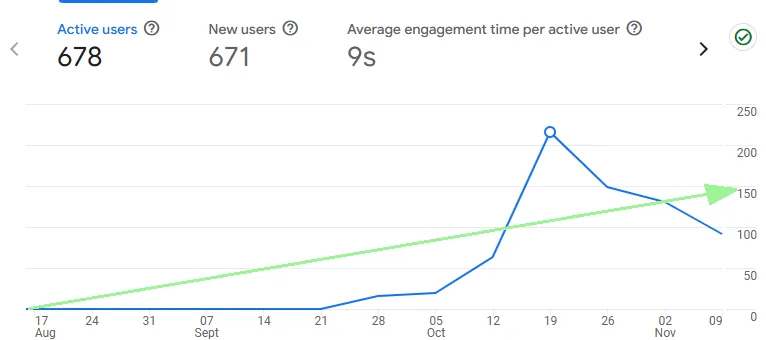
    The results were immediate and dramatic. Within a matter of weeks post-relaunch, the site saw 60 new users: a 233% increase from the 18-user baseline. The following week reached 213 new users. This growth proved sustainable, with months 2-3 maintaining 130-150 weekly users: a 650% sustainable improvement over the 20-user average from months before transformation. This converted a chronically invisible site into a consistent lead-generation engine.

    The traffic quality told the whole story. Organic users showed exceptional engagement, averaging 74.8 seconds on site with a 59.52% engagement rate: both significantly above typical benchmarks for AI-sourced traffic, suggesting that the semantic architecture was effectively positioning the site as an authoritative source worthy of deeper exploration. The homepage click-through rate improved to 6.36% when displayed, up from near zero. Perhaps most tellingly, 91% of new traffic arrived as ‘Direct’: a proxy metric for AI referrals, since ChatGPT and similar platforms typically don’t pass referrer data. While ‘Direct’ traffic can include bookmarks and word-of-mouth, the combination of sustained high engagement (74.8 seconds on-site), 59.52% active engagement rate, and high conversion intent strongly suggests a significant portion originated from AI platforms.

    Google Analytics Active Users Growth September - October 2025 from 0 users to 200+ spike and 150 avg sustainable users - for Contentifai case study

    Active Users Growth from September – October 2025: showing from 0 users to 200+ spike returning to 150 avg. sustainable users.

    The transformation sustained itself. Months two and three maintained 130-150 weekly users, a 650% improvement over the pre-transformation baseline. The site began appearing in AI citations for industry-specific queries. Each new piece of content strengthened the semantic web, making AI systems increasingly confident in their recommendations.

    Traditional SEO metrics improved as well. The comprehensive content structure and improved user signals lifted search rankings across the board. But the real victory was achieving what keyword optimisation never could: becoming a trusted source for AI-driven discovery.

    Expertise Now Discoverable by AI and Humans

    This semantic transformation succeeded because AI systems process content through vector similarity, not keyword matching. By building for semantic understanding rather than keyword density, the site became discoverable by both humans and the AI systems that increasingly guide B2B decisions.

    The approach scales across professional services, technology, and financial sectors. Any B2B expertise can be transformed for AI discovery using these principles. But with AI search growing 40% monthly, the window for first-mover advantage is closing.

    Your expertise deserves to be discoverable by both humans and the AI systems that shape modern B2B purchasing. The question isn’t whether to adapt for AI discovery, but how quickly you can make the transformation.

    Ready to transform your website for AI discoverability?

    Let’s discuss how semantic architecture can unlock your content’s potential. Book a discovery call to explore your AI SEO transformation.


    A Note on The Methodology

    These results reflect one professional services firm’s specific circumstances, audience, and market position between September and December 2025. While the semantic SEO framework applies broadly, traffic improvements will vary based on existing domain authority, content baseline, and market competition.

GDPR Cookie Consent with Real Cookie Banner