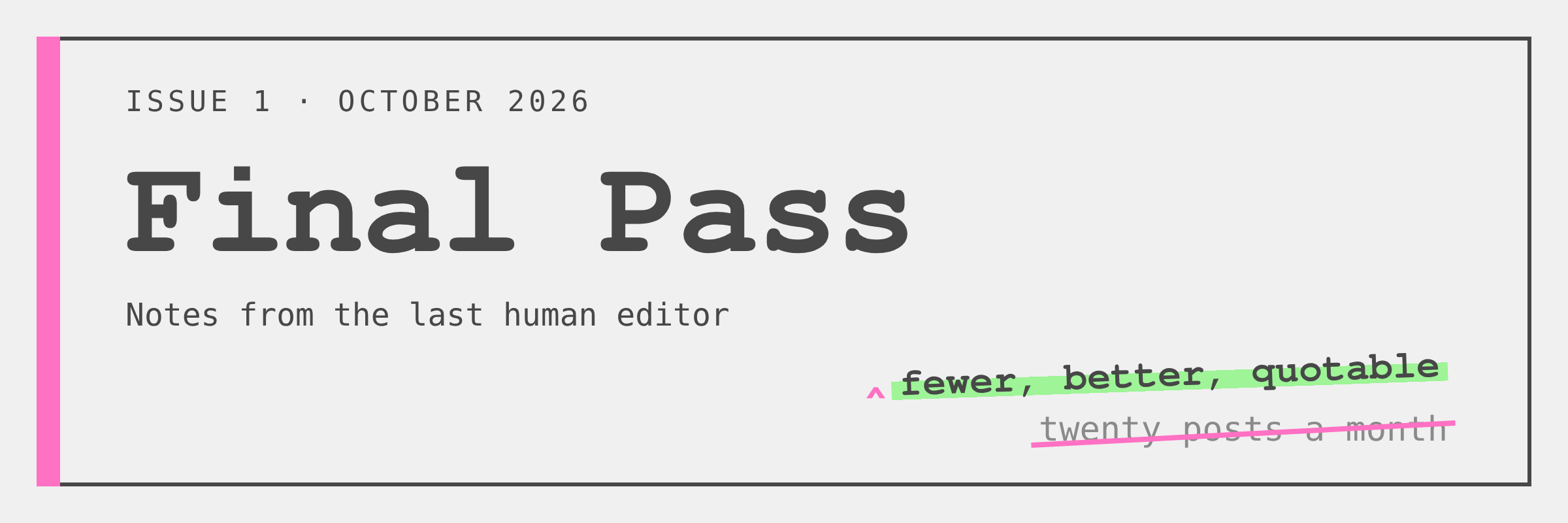
Twenty posts a month gives you 240 pages to look after within a year. Two good posts a month, each one specific enough that only you could have published it, will do more for your readers, your sales team and your visibility in AI search.
This is the first issue of Final Pass, our monthly newsletter, sent to subscribers on Thursday 15 October 2026 and republished here a few weeks later. Each issue carries one argued take on B2B content, a few notes from our own work, and three links worth your time. Final Pass lands in inboxes a week before it appears anywhere else: subscribe here.
Welcome to the first issue of Final Pass. Once a month I’ll pick one thing in B2B content that’s worth arguing about, and add a few notes and observations from my own experiences.
Fewer, better, quotable
Over the past couple of weeks I gave our own blog its first final pass, and cut it roughly in half. It’s something I do for clients all the time, and it was long overdue on our site. We had 127 posts going back to 2023, and most of them weren’t pulling any traffic. A good number were AI writing tips from the early ChatGPT days, written to catch a wave of interest at the time, though the bigger problem now is that they’re simply out of date. There’s very little anyone could do to bring them back up to date in a way readers would find engaging now. So we decided to retire 26 of them, fold more than 30 others into stronger posts, and rewrite 15 of the ones we kept, leaving around 64 posts: all of them about the work we do today.
Cleaning up three years of publishing took a little over a week, and it taught me more about content volume than publishing at scale ever could.
Twenty posts a month gives you 100 posts after five months and 240 after a year, every one of which needs checking, updating when the facts change and, sooner or later, merging or deleting, so a big site soon becomes hard to maintain. The “content machines” businesses build are usually great at producing content, but keeping that content up to date, relevant and engaging is a completely different game, and a lot of businesses race to publish without thinking about how they’ll look after it once it’s out there.
Right now two forces are grinding against each other too. On one side, businesses can produce more than ever: the Content Marketing Institute’s preview of its latest research, published on 29 September, found that 88% of B2B marketers say their organisation uses AI content creation tools, with 60% expanding that use in the last year (CMI, 2026). My read on that is we’re going to see a lot more content from the brands we follow. Yet, on the other side of the equation, Google is tightening the rules, with two spam updates in as many months: one in August and a second that took two weeks to roll out and finished on 8 October. Its spam policies already name the problem: many pages produced mainly to rank, which Google calls scaled content abuse, “no matter how it’s created”. Content marketers and marketing teams sit somewhere in between, with AI tools that let us publish more than ever on one side and search engines setting ever stricter rules on what their ranking systems reward on the other. Robert Rose at CMI named the weak spot in all that extra capacity we now have at our fingertips far more neatly than I could and with a bit more bite: “Speed was never our problem. Direction was.”
When clients have asked me for volume, more often than not it has been for sales reasons. They want to be everywhere and front of mind, and more content looks like more noise in the market. I understand the instinct, but once we talk through what twenty posts a month means for the site six months from now, the managing, the auditing and the updating, most of them quickly see it for what it is, a fool’s errand. Being everywhere all the time has limited benefit, even for sales.
Getting clients to let go of content can be a harder conversation, because there’s often an emotional side to it, particularly with older posts they may have helped write themselves, so I’d often rather respect that attachment than argue with it. Showing them the numbers usually helps, since a post that isn’t pulling any traffic and no longer serves a purpose is hard to defend. Traffic is only part of the picture, though. A case study with a clear point of engagement can attract a handful of visits and still be among the most valuable pages on the site, because the few people reading it are the ones making the decision, and some posts are better updated or improved than cut. When the clean-up sits inside a wider website audit, with a faster, more responsive site and a better experience for every visitor at the end of it, letting go of one post tends to stop feeling like a loss.
The competitor test: one question for any post
So what’s worth keeping, and worth writing in the first place? The test I use is simple enough to run on any post: could you take it, put it on a competitor’s website without changing a word, and would it still make sense? If the answer is yes, it’s probably not worth publishing, let alone quoting. If the answer is no, because it’s built on your credentials, your clients, your case studies and your unique view of your sector, then you’ve got something quotable that’s worth publishing and sharing.
“Quotable” means two things to me now, and they work in much the same way. AI tools need something specific to cite when a buyer asks a question that doesn’t include your name, which is exactly where every B2B firm wants to have a presence, and they need it again when someone who has already found you runs their due diligence through an AI assistant. People need the same thing, whether that’s someone in procurement quoting you in a proposal or a manager mentioning you to whoever signs off the budget. Sometimes AI quotes you first and the person follows, sometimes it’s the other way round, but either way, generic content gets neither.
Two good posts a month, each one specific enough that only you could have published it, will do more for your readers, your sales team and your visibility in AI search than twenty that could sit on anyone’s site, and they leave you far less to clean up later.
What sits underneath: notes from our website AI readiness checks
Tidying a blog is only half the job, because the site underneath has to run like a well-oiled machine for the people and AI tools reading it, and that’s what our AI readiness checks look at. We go into each one knowing as little about the brand as we can, on purpose, so the readback is close to how a stranger, or an AI tool meeting you for the first time, sees you right now. These are the three patterns I see most often, and they’re worth checking on your own site.
The foundations get missed: homepage metadata that was never added, an old homepage still sitting behind the current one, and key pages set to noindex, which tells search engines to leave them out entirely. They usually slip through at set-up, they’re quick to fix with the right know-how, and the fix helps everything from technical SEO and accessibility to the visitor’s experience, as well as AI.
The proof lives somewhere else: awards, listings, PR coverage, named clients and quotes often sit on other people’s websites with no mention on the firm’s own, so I recommend clients at least mention these highlights on their own domains, even as a short press release or a banner on a key page. The same goes for your name, address and phone number: keep them consistent across sites, because small differences creep in over the years and chip away at a machine’s confidence in citing you.
Some firms are going all in on the AI wave: at the opposite extreme from the neglected sites, we’re seeing freshly rebuilt sites with most of the design stripped out and pages close to pure markdown, built for AI readers first. It’s a bold bet on one direction things could go, which isn’t here yet but is still possible, so we talk it through with clients and help them decide how far they want to go down this rabbit hole.
Quality over quantity, as always
At Contentifai we’ve always been about quality over quantity, and giving our own blog a final pass reminded me why. If you take one thing from this issue, pick five of your oldest posts this week and run the competitor test on them: anything that would sit happily on a rival’s site is a candidate to rewrite, merge or let go, and anything only you could have written is worth protecting. I’ll be back next month with another take, and in the meantime, if you have a post you’d cut first (or one you’d never let go of), reply to the email if you’re a subscriber, or write to hello@contentifai.agency and tell me about it.
Best wishes,
Jeremy
Three links, if you’re curious to read more
- The Robot Buyer Isn’t Here Yet, Robert Rose, Content Marketing Institute (29 September 2026).
- Spam policies for Google web search, Google Search Central. The dates of both recent updates are on Google’s Search Status Dashboard: August and September.
- How to track AI traffic on your website, Contentifai.
Get the next issue of Final Pass a week before anyone else
Final Pass goes to subscribers on the third Thursday of every month, and each issue is republished here a few weeks later. If you’d rather read it first, subscribe at contentifai.agency/final-pass-newsletter. Jeremy writes every issue himself, and you can unsubscribe in one click.
If you’d like to see how your website reads to someone meeting you for the first time, we’re running complimentary AI readiness checks until 27 November 2026.
Header image created with the help of Claude Opus 5.5 (Anthropic).