
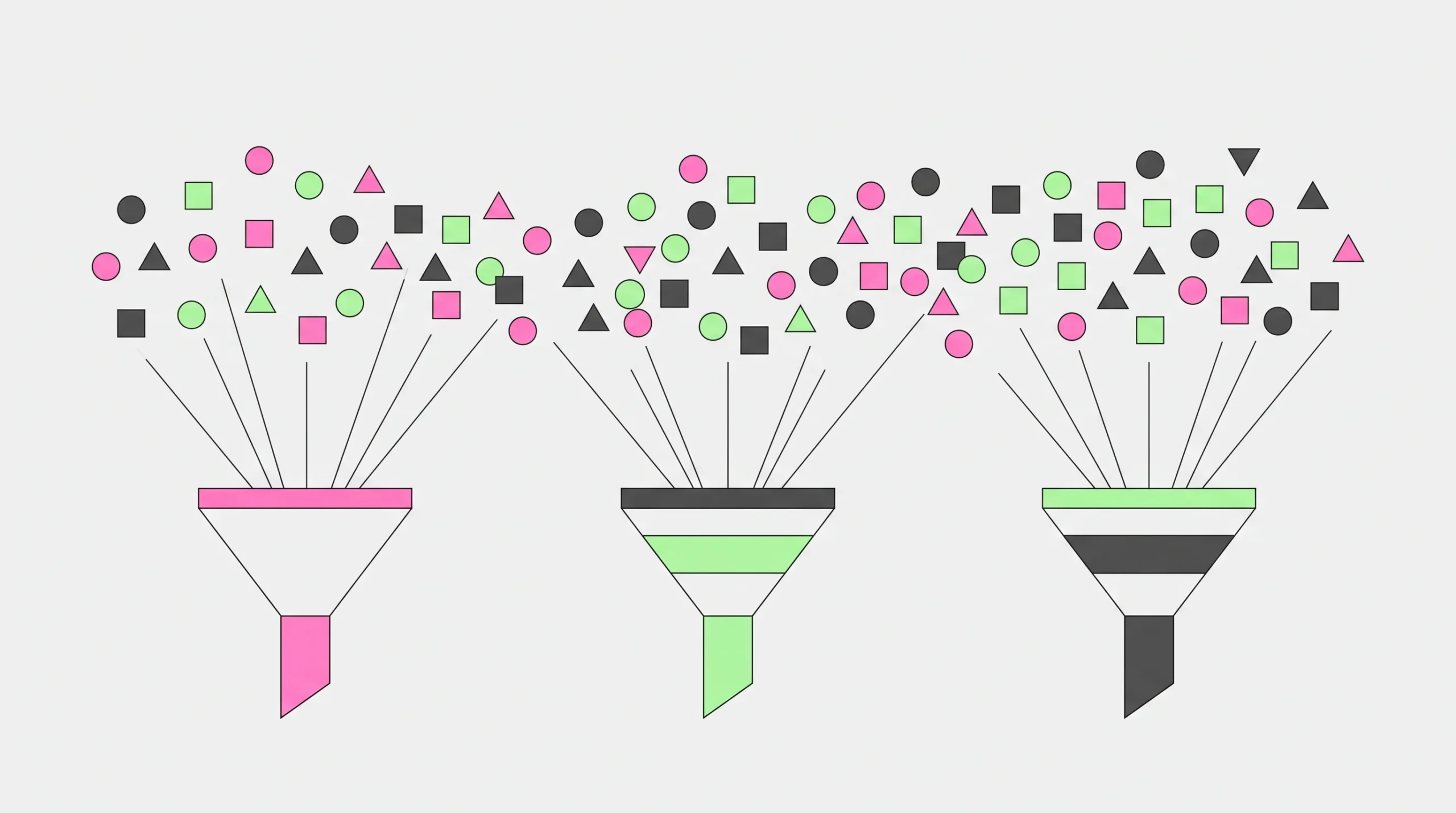
There is no directory, platform or partnership that guarantees AI visibility, because the tools your buyers ask draw from different wells. Here is what sources ChatGPT, Perplexity and Google’s AI lean on, why consistency across all of them beats depth in any one, and the single document that makes consistency manageable.
The silver bullet nobody can sell you…
A new category of pitch is landing in B2B inboxes: get listed here, join this platform, buy this placement, and the AI tools will start recommending you. It is an appealing promise, and it fails on the first fact about how these systems work. There is no single source that, once secured, gets a brand chosen by AI, and anyone selling one deserves your scepticism.
The honest picture is less convenient, but fortunately more workable. AI answers are assembled from many places at once, the places differ by engine, and no one of them dominates. This means the winning behaviour is not finding the secret door; it is being consistently, verifiably present across the ordinary ones.
What sources does ChatGPT use? (And Google, and Perplexity)
Run the same category question through ChatGPT, Perplexity and Google’s AI and you rarely get the same reading list back. It is a pattern anyone can confirm in ten minutes, and one we see repeatedly in our website AI readiness checks: a brand cited by one engine from a trade-press mention, missing from the second, and surfaced by the third through a directory profile nobody remembers creating. The sources are scattered, and each engine has its own habits. Kantar’s Chosen by AI tracking puts numbers on both halves of that. In its travel-category analysis, the single most influential source held a share of only around 5% of citations, ahead of a long tail of smaller ones, and the engines leaned different ways: Google’s AI Overviews toward established information and comparison sources, ChatGPT toward lifestyle publishers, Perplexity toward news and community discussion (Kantar, 2026). Ask three tools the same question and you are, in effect, asking three readers with three different bookshelves. We saw the same thing from the technical side in our guide to how AI crawlers read your website: visibility in one engine tells you little about the next.
So, two practical conclusions follow on from this. Being well represented in one place, even an influential one, cannot carry your visibility across engines. Chasing each engine’s current taste is a losing game, because the tastes differ, shift, and are never published. What survives all of that is a broad, consistent presence.
The quiet killer we find in audits
Here is what undermines that presence in practice: inconsistencies in the listings that already exist. We’ve run enough brand checks to spot the predictable patterns: a slightly different company name here, an old address there, two phone numbers in circulation, three versions of the one-line description… None of them are wrong exactly, but none of them match either.
Humans read past those differences without noticing. Machines find them much harder to reconcile. A system weighing sources that disagree about your basic facts becomes less certain you are one verifiable entity, and less certainty means less likelihood of citation. The damage is silent, sits across dozens of pages nobody reviews, and compounds every time a new profile gets created from memory rather than from a source of truth.
A ten-minute check shows whether it has happened to you. Open your Google Business Profile, your Companies House record, your LinkedIn company page and the three directories your sector uses most, and put the name, address, phone number and one-line description from each side by side. If any column has more than one version, assume the machines have found it too.
In our AI readiness checks, inconsistent core facts across standard directories are among the most common findings, and the businesses involved are almost never aware of it. It’s best practice to get these issues fixed ASAP before they accumulate.
The fix: one brand credentials document, signed off, used everywhere
The recommendation we give every client is unglamorous but it works: create a single brand credentials document, confirm every fact in it, have it signed off, and make it the only source anyone draws from, internally or externally, when your business details are written down anywhere.
It should hold the exact legal name and trading name, the approved short and long descriptions, address, phone number, email, URLs and social profiles, founding facts, and the small set of claims you are prepared to stand behind. Give it a version number, a date and a named owner, so that a change to the phone number becomes a document change first and a listings sweep second. Finance teams run supplier and payment details with exactly this rigour because errors cost money. Brand facts deserve the same treatment, because in AI search, errors now cost visibility.
The reason this matters beyond tidiness is the breadth of what machines read. Your own site, social profiles, reviews, video, directories and other people’s write-ups all feed the same answer, which is why brands need to be represented accurately across that whole scattered pool of sources rather than merely discoverable in one (Kantar, 2026). One document, drawn on everywhere, is how a small team keeps a scattered footprint saying one thing.
See how consistently your brand reads to machines
Our complimentary AI Readiness Check reviews your visibility across ChatGPT, Perplexity and Google’s AI, and checks the entity consistency underneath it, in one prioritised report.
Where to spend effort instead of chasing a secret source
With the silver bullet off the table, the priorities are refreshingly ordinary. Make your own site fully readable to machines, since it is the one source you control outright. Fix the consistency of your existing footprint before adding to it; a corrected directory profile beats a new one. Earn presence in independent places, reviews, press, industry directories and named case studies, because third-party corroboration is what the trust frameworks reward, as our guide to E-E-A-T explains. And check your results across more than one engine, because, as everything above shows, no single tool’s answer speaks for the rest.
Many wells, one story
No single source gets you chosen, and that is workable news: it means nobody can buy the position you are building, and it means the job is definable. One set of confirmed facts, told the same way everywhere machines look, on a site they can read, corroborated by places you do not control. It is also why brand size does not decide AI visibility: the footprint that gets a brand cited is built, not bought.
For the wider picture, start with our plain-English guide to AEO, or request a complimentary AI Readiness Check and we will show you how consistently your brand reads today.
Frequently asked questions about AI search sources
The questions we hear most about where AI answers come from.
What sources does ChatGPT use?
ChatGPT builds answers from its training data plus, for search-style queries, pages fetched from across the live web. Kantar’s category tracking found it leans toward lifestyle and publisher content more than other engines do, with no single source dominating. Its mix differs from Google’s AI Overviews and Perplexity.
Do Google AI Overviews and ChatGPT use the same sources?
They overlap without matching. Kantar’s tracking found Google’s AI Overviews favour established information and comparison sources while ChatGPT leans toward publishers, and Perplexity toward news and community discussion. Presence in one engine’s answers does not carry over automatically.
What sources does Perplexity use?
Perplexity fetches and cites live web sources with each answer, and Kantar’s tracking found it leans toward news and community discussion more than other engines. Its visible citations make it a useful tool for checking which sources currently represent your category.
Is there a directory that guarantees AI visibility?
No. Measured source data shows even the most influential single source holds only a few percent share of AI citations, with a long tail behind it. Directories help as part of a broad, consistent footprint; none of them is a shortcut, whatever the sales pitch says.
Why does my brand appear in one AI tool but not another?
Because each engine draws on different source types and weighs them differently. A brand well represented in the sources one engine prefers can be absent from another’s. That is normal, and it is why visibility should be checked across several tools rather than one.
What should a B2B brand keep consistent across sources?
The core entity facts: exact business name, description, address, phone, email, web and social URLs, and founding details. Keep them in one signed-off brand credentials document and draw every listing, profile and mention from it, so machines meet the same verifiable facts everywhere.